Private Fungi & Forest Ecology Expedition in La Fortuna
A field expedition into one of the least visible parts of the rainforest.
Approximately 3 hours · Private experience · La Fortuna, Costa Rica
Most of the fungus is not the mushroom
A mushroom may last a few days.
The organism that produced it can persist far longer, growing through soil, wood, leaf litter or another living organism.
That simple change in perspective transforms the way we look at fungi.
Instead of walking through the forest searching only for colorful mushrooms, we begin asking what the fungi are actually doing.
Breaking down wood.
Recycling nutrients.
Living with plant roots.
Parasitizing insects and other fungi.
Interacting with animals.
Transforming dead material into something the forest can use again.
Fungi are not a decorative layer of the rainforest.
They are participants in many of the processes that allow the forest to function.
The forest from a fungal perspective
This expedition is built around observation rather than a predetermined species list.
We search slowly through fallen wood, leaf litter, living trees, decaying vegetation and other microhabitats where fungal activity becomes visible.
A small fruiting body on a branch can lead us into decomposition.
A fungus emerging from an insect can open a conversation about parasitism and host specialization.
A cluster of mushrooms beside a tree can lead us underground, toward the relationships between fungi, roots, nutrients and carbon.
Leafcutter ants can take us in another direction entirely: agriculture did not begin with humans. These insects cultivate fungi inside their colonies as the central component of their food system.
One organism can open several different doors.
Decomposition is not disappearance
A fallen tree does not simply vanish.
Its structure is dismantled through interactions among fungi, bacteria, insects and other organisms.
Fungi are particularly important because some are capable of breaking down complex components of wood that many other organisms cannot process efficiently.
What appears to us as decay is therefore also transformation.
Carbon moves.
Nutrients become available again.
New organisms occupy old material.
The forest repeatedly builds itself from what has died.
During the expedition, dead wood and leaf litter become places to investigate rather than things to step over.
Fungi and plants
Many fungi live in close association with plant roots.
These relationships are called mycorrhizae.
Depending on the organisms involved, fungal hyphae can increase the volume of soil explored beyond the roots themselves and participate in exchanges involving water, mineral nutrients and carbon compounds.
The details matter.
There is not one universal “fungal network” operating beneath every forest in the same way, and popular descriptions sometimes make these relationships sound more intentional or coordinated than the evidence allows.
We approach them as biological interactions:
complex, diverse and still actively researched.
Parasites in the understory
Some of the most remarkable fungi in tropical forests do not grow from wood or soil.
They grow from animals.
Members of groups such as Cordycipitaceae and Ophiocordycipitaceae include fungi associated with insects and other arthropods.
When we encounter one, the host is part of the observation.
What was infected?
Where did the host die?
Where is the fungal reproductive structure emerging?
What might that position mean for spore dispersal?
Some entomopathogenic fungi can alter aspects of host behavior, but the mechanisms vary greatly between fungal and host lineages.
Rather than reducing these organisms to “zombie fungi,” we look at what is actually known — and what remains uncertain.
Symbiosis, parasitism and everything between
The forest is full of relationships that resist simple categories.
Some fungi exchange resources with plants.
Some kill their hosts.
Some live within healthy plant tissues without producing obvious symptoms.
Some compete with other fungi.
Some form lichens together with photosynthetic partners.
Others have relationships that we still understand poorly.
This is one of the reasons fungi are such an interesting way to explore ecology.
They force us to look beyond individual organisms and toward interactions.
Identification without pretending certainty
Fungi can be difficult to identify.
Many species cannot be reliably determined from a photograph or visible fruiting body alone. Microscopic characters, chemical reactions, substrate information or DNA may be necessary.
We do not turn uncertainty into a confident species name simply because a guest expects one.
When a field identification is appropriate, we make it.
When only a genus, family or broader group can reasonably be suggested, we say so.
And when the answer is simply “we don't know yet,” that is also a valid scientific answer.
Useful observations can be documented photographically and, when appropriate, uploaded to biodiversity platforms such as iNaturalist where additional identification may develop over time.
What might we find?
There is no fixed list.
Depending on rainfall, season, substrate and location, observations may include:
mushrooms and other fruiting bodies,
bracket and crust fungi,
cup fungi,
coral-like forms,
jelly fungi,
slime molds encountered alongside fungi,
lichenized fungi,
fungi associated with decaying wood,
fungal parasites of plants,
and entomopathogenic fungi associated with insects and other arthropods.
Not everything we stop to examine will necessarily be a fungus.
That distinction itself can become part of the experience.
Rain changes the expedition
Fungal fruiting responds strongly to environmental conditions.
Rainfall and humidity can produce dramatic changes in what becomes visible above ground, which is why the wetter parts of the year can be particularly rewarding.
But fungi do not disappear during drier periods.
The expedition simply changes.
We may focus more on persistent fruiting bodies, decomposition, lichens, host associations, microhabitats and traces of fungal activity that remain visible when ephemeral mushrooms are less abundant.
There is no guaranteed species list or guaranteed number of mushrooms.
The conditions determine what the forest gives us to work with.
Private by design
This is a slow experience.
Your guide works only with your party, allowing us to spend twenty minutes with something that another tour might pass in twenty seconds.
If we find an unusual fungus associated with an insect, we can investigate it.
If you are interested in macro photography, we can work carefully with a single subject.
If your interest is ecology rather than taxonomy, we can spend more time discussing processes and relationships.
There is no obligation to maintain a generic script.
Photography and field documentation
Fungi are excellent subjects for macro and close-up photography.
They also present unusual challenges: extremely small subjects, reflective surfaces, dark forest conditions and structures that can be difficult to photograph without disturbing the surrounding substrate.
We can work with cameras or phones and spend time finding angles that document diagnostic features as well as producing aesthetically strong images.
Nothing needs to be collected simply to make a photograph.
When scientifically useful, we can also document substrate, scale, host organism and habitat — information that can make an observation much more valuable than a photograph alone.
Expedition details
Duration: Approximately 3 hours.
Format: Private — only your party and your guide.
Recommended group size: 1–4 guests.
Location: La Fortuna / Arenal region, Costa Rica. The site is selected according to recent rainfall, habitat conditions, accessibility and your interests.
Difficulty: Usually easy to moderate walking. Expect humidity, mud, roots and uneven forest terrain.
Timing: Can be conducted during daylight or after dark depending on conditions and objectives.
Private expedition: US$265 for 1–2 guests.
Additional guests: US$75 each.
Entrance fees to the selected site are included.
Extended half-day or full-day fungal field expeditions can be arranged privately.
What to bring
Closed-toe shoes with good grip.
Water.
Rain protection.
A camera or phone if you enjoy photography.
A small flashlight or headlamp can be useful depending on the departure time.
A hand lens is welcome if you have one, but specialized equipment is not required.
Frequently asked questions
Is this a mushroom-foraging tour?
No.
The purpose is observation, ecology, interpretation and documentation rather than collecting edible mushrooms.
We do not consume wild fungi during the expedition based on field identification.
Is the experience only available during the rainy season?
No.
Rainier periods usually produce more visible fruiting bodies, but fungal ecology can be explored throughout the year.
The organisms and questions we focus on change with conditions.
Will we see Cordyceps or “zombie-ant fungi”?
Possibly, but never guaranteed.
Several lineages of fungi parasitize insects and other arthropods in tropical forests, and these are subjects we actively look for when suitable habitat and conditions are present.
Finding one is an opportunity to discuss the biology carefully rather than repeating the simplified stories usually associated with “zombie fungi.”
Can you identify every mushroom we find?
No — and anyone claiming that they can should make you cautious.
Some fungi can be identified reasonably well in the field, while others require microscopy, chemistry, genetic data or specialist examination.
Scientific accuracy is more important than supplying a name for everything.
Can I photograph the fungi?
Absolutely.
This expedition is particularly suitable for macro and close-up photography, and because it is private we can dedicate time to individual subjects.
Do you collect specimens?
The standard experience is observation-based.
We do not remove organisms simply because they are interesting.
Any activity involving scientific collection would require an appropriate research purpose and compliance with Costa Rican regulations.
Are other animals part of the experience?
Yes.
A forest cannot realistically be divided into fungi, insects, plants and vertebrates while we are standing inside it.
An insect host, leafcutter colony, decaying tree, frog or bird may become directly relevant to understanding the fungus or ecological process in front of us.
Look closer
Fungi are easy to overlook.
Some are only a few millimeters tall.
Others remain almost entirely hidden inside soil, wood or living tissue.
But once you begin noticing what they are doing, the forest becomes difficult to see in the same way again.
A fallen branch becomes habitat.
A dead insect becomes evidence.
A tree root becomes a potential partnership.
Decay becomes nutrient cycling.
And a mushroom stops being the organism itself and becomes one visible moment in a much larger life.
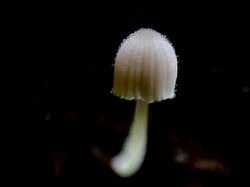
Some of our field observations:
 |  |  |  |
|---|