Private Birdwatching Expedition in La Fortuna
Private birding experience · La Fortuna / Arenal · Approximately 4 hours
Birdwatching changes once identification is no longer the end
There is satisfaction in putting a name to a bird.
But the name opens more questions.
Why is it feeding here?
Why does this species remain near the forest floor while another occupies the canopy?
What produced that bill shape?
Why is one bird defending a territory while another is moving through in a mixed-species flock?
Where was a migrant only a few months ago?
What does a call tell us that a visual observation cannot?
This private expedition combines bird identification with behavior, ecology, evolution and field observation.
We keep the species list.
We simply do not stop there.
La Fortuna is not one birding habitat
The Arenal region sits within a complex landscape of lowland rainforest, secondary forest, forest edge, wetlands, agricultural areas, gardens and elevational transitions.
Different habitats produce different bird communities.
A pasture edge can be valuable for raptors and open-country species.
Secondary forest can support fruit-eating birds, mixed flocks and dense understory activity.
Wetlands change the community completely.
Mature forest presents another set of challenges, where vocalizations and subtle movements can matter more than obvious visual detections.
The site is therefore selected according to conditions, season and what you want from the morning rather than forcing every birder onto the same trail.
Learning to detect birds
Experienced birding is as much about detection as identification.
Movement.
Shape.
Silhouette.
Flight pattern.
Habitat.
A single note.
A distant call.
The direction another bird is looking.
The alarm behavior of a group.
Sometimes the bird is visible for several minutes.
Sometimes we have only a sound and a few seconds of movement inside vegetation.
Learning what information matters can turn a forest that initially seems quiet into a landscape full of signals.
Birding by sound
In tropical forest, many birds are heard before they are seen.
Vocalizations can reveal species hidden behind vegetation, individuals occupying different territories, mixed flocks moving through the forest and birds that would otherwise remain undetected.
We can work with:
calls and songs,
repetition and variation,
direction and distance,
habitat context,
similar vocalizations,
and the limits of identification by sound.
Audio-recognition tools can be useful aids, but they are not substitutes for field judgment.
An identification should fit the sound, location, habitat and biological context rather than being accepted simply because an application suggested a name.
Behavior before checklists
A species count tells us something useful about an outing.
Behavior often tells us more about the individual bird in front of us.
Feeding.
Preening.
Territorial defense.
Courtship.
Nest construction.
Flocking.
Predator response.
Fruit selection.
Foraging with another species.
Migration.
A familiar bird behaving interestingly can become a more valuable observation than a rare bird disappearing immediately into vegetation.
The expedition allows time for both.
Migration changes the forest
The bird community around La Fortuna is not static throughout the year.
Resident species share the landscape seasonally with migrants moving between breeding and non-breeding areas across the Americas.
Migration adds another scale to the experience.
A small bird feeding in Costa Rica may have crossed countries, mountain ranges and large bodies of water before reaching the tree in front of us.
Other movements happen within Costa Rica itself as birds respond to elevation, flowering, fruit availability and seasonal conditions.
Knowing when and why birds move helps explain why the same location can feel very different at different times of year.
Mixed-species flocks
One of the most interesting moments in tropical birding can begin when several species appear together.
A mixed flock is not simply a random concentration of birds.
Different species may move through the forest together while using different substrates, heights and foraging strategies.
Woodcreepers, tanagers, warblers, flycatchers and other birds can occupy the same moving group while exploiting different resources.
Following these flocks requires patience.
It can also reveal how multiple species partition the same forest.
Identification without pretending certainty
Not every bird gives us a perfect view.
Flycatchers can be difficult.
Immatures may look very different from adults.
Molting birds complicate plumage.
Lighting can alter apparent color.
Some vocalizations overlap.
And occasionally the correct field identification is simply not certain.
We make the most precise identification the evidence supports.
When a bird can confidently be identified to species, excellent.
When the available information supports only a genus or species group, that distinction matters.
Accuracy is more valuable than adding another name to the list.
eBird and field documentation
Birdwatching produces useful biological information when observations are documented carefully.
When appropriate, the expedition can be recorded through an eBird checklist including location, effort and the species detected during the outing.
Interesting observations can receive additional documentation through photographs, audio or field notes.
These records contribute most when the information is accurate.
A checklist should document what we actually detected, not what we expected to find.
For beginning birders
You do not need to know bird families, own expensive binoculars or maintain a life list.
We can begin with the fundamentals:
how to locate a bird with binoculars,
how to describe where it is,
which field marks matter,
how to listen,
how habitat narrows possibilities,
and how to use a field guide or identification application critically.
Birding becomes considerably easier once you understand what information to collect before the bird disappears.
For experienced birders
If you already bird seriously, there is no need to turn the morning into an introductory lesson.
We can instead focus on:
target species,
difficult groups,
vocalizations,
habitat selection,
migration,
local distribution,
photographic opportunities,
behavior,
or simply maximizing meaningful field time.
Before the expedition, tell me what you have already seen and what interests you.
That helps determine where we go and how we use the morning.
Difficult birds are part of the fun
Some groups refuse to cooperate with simple identification rules.
Flycatchers.
Woodcreepers.
Warblers in changing plumages.
Swifts overhead.
Raptors at distance.
Immature birds.
Rather than pretending those difficulties do not exist, we use them.
Structure, behavior, habitat, voice, proportions and probability all become pieces of evidence.
A difficult identification can sometimes teach more than an obvious one.
Birds do not exist separately from the forest
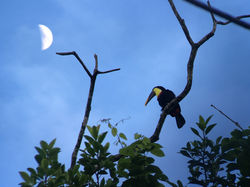
A toucan feeding on fruit is also part of seed dispersal.
A hummingbird visiting flowers introduces questions about energy, pollination and coevolution.
A woodpecker excavating a cavity may create habitat later used by organisms that cannot excavate their own.
A raptor changes the behavior of potential prey simply by being present.
A migratory warbler connects this forest to ecosystems thousands of kilometers away.
That is why plants, insects, fungi and other wildlife are not distractions during a birding expedition.
They help explain the birds.
Photography
Bird photography is welcome.
If photography is important to you, we can adjust the pace and site selection accordingly.
That may involve:
anticipating behavior,
working with direction of light,
selecting backgrounds,
maintaining appropriate distance,
waiting for feeding routes or repeated movements,
and balancing observation with photographic opportunity.
Wildlife is never repositioned or deliberately stressed to create a photograph.
Guests seeking a photography-first experience may prefer our dedicated Private Wildlife Photography Field Experience.
Private by design
Birding works differently when a group is small.
There is less noise.
Communication is easier.
We can stop without worrying about holding up unrelated guests.
Experienced birders can move quickly when appropriate.
Beginners can take time to find the bird.
Photographers can wait for another opportunity.
And when something unexpected happens, we can change the plan.
Your party is the expedition.
What might we encounter?
The exact species depend on habitat, season, weather and chance.
The Arenal region can produce toucans, aracaris, tanagers, hummingbirds, trogons, motmots, woodpeckers, woodcreepers, flycatchers, antbirds, wrens, raptors, waterbirds, migratory warblers and many other groups.
But there is no guaranteed species list.
Birds move.
Fruit disappears.
Flowers change.
Weather alters activity.
Migration changes the community.
Good birding works with those variables rather than pretending they do not exist.
Dawn matters — but it is not the only option
Early morning is generally the strongest period for bird activity and is the recommended departure for a dedicated birding expedition.
But objectives matter.
Wetland birding can follow different rhythms.
Raptor activity may improve later as thermal conditions develop.
Photography may depend on a particular light direction.
Some target species require different timing.
We select the schedule according to what you are trying to accomplish.
Expedition details
Duration: Approximately 4 hours.
Format: Fully private — only your party and your guide.
Recommended group size: 1–4 guests.
Location: La Fortuna / Arenal region, Costa Rica.
Site selection depends on season, recent observations, habitat, weather and your objectives.
Recommended departure: Early morning for general birding. Other schedules can be arranged for specific objectives.
Private birdwatching expedition: US$295 for 1–2 guests.
Additional guest: US$80.
Standard entrance fees to the selected site are included.
Half-day, full-day and custom birding itineraries can be arranged.
Before the expedition
If you already bird, send me:
your target species,
your eBird life list or target list if you use one,
species you have already seen in Costa Rica,
whether photography is a priority,
and any particular habitats or bird families that interest you.
For beginners, none of this is necessary.
Curiosity is enough.
What to bring
Comfortable closed-toe walking shoes.
Water.
Light rain protection.
Binoculars if you have them.
Camera if desired.
Field guide or birding apps if you use them.
Neutral clothing is useful but specialized birding clothing is not required.
Frequently asked questions
Is this a private birdwatching tour?
Yes.
The expedition is reserved exclusively for your party.
Is this suitable for serious birders?
Yes.
The itinerary can be built around target species, habitats, difficult identifications, vocalizations or maximizing birding time.
Is it suitable for someone who has never gone birdwatching?
Absolutely.
Private guiding is particularly useful for beginners because we can teach detection, binocular use and identification without pressure to keep up with an experienced group.
Can we search for specific species?
Yes, when the requested species is realistically possible in the region and season.
We can select habitat and timing accordingly, but wild birds are never guaranteed.
Do you use playback?
Playback is not treated as an automatic bird-finding tool.
Any use must consider species, context, breeding status, level of disturbance and the presence of other birding groups.
There are situations where avoiding playback is the more responsible choice.
Do you submit an eBird checklist?
When appropriate, the outing can be documented as an eBird checklist with effort and location information.
Is bird photography possible?
Yes.
Tell us beforehand if photography is a major priority because this can change site selection, timing and pace.
Are entrance fees included?
Yes.
Standard entrance fees for the selected site are included in the expedition price.
Can we book a full day?
Yes.
Longer itineraries can combine different elevations and habitat types depending on objectives, travel time and season.
A bird is never just a bird
Identification gives us a name.
Observation gives us a life.
The same bird can become a lesson in migration, competition, seed dispersal, biomechanics, communication, evolution or forest structure depending on what it is doing when we find it.
That is the reason we go birding.
Not simply to finish a list.
To keep discovering what the list contains.
 |  |  |  |
|---|---|---|---|
 |  |  |